
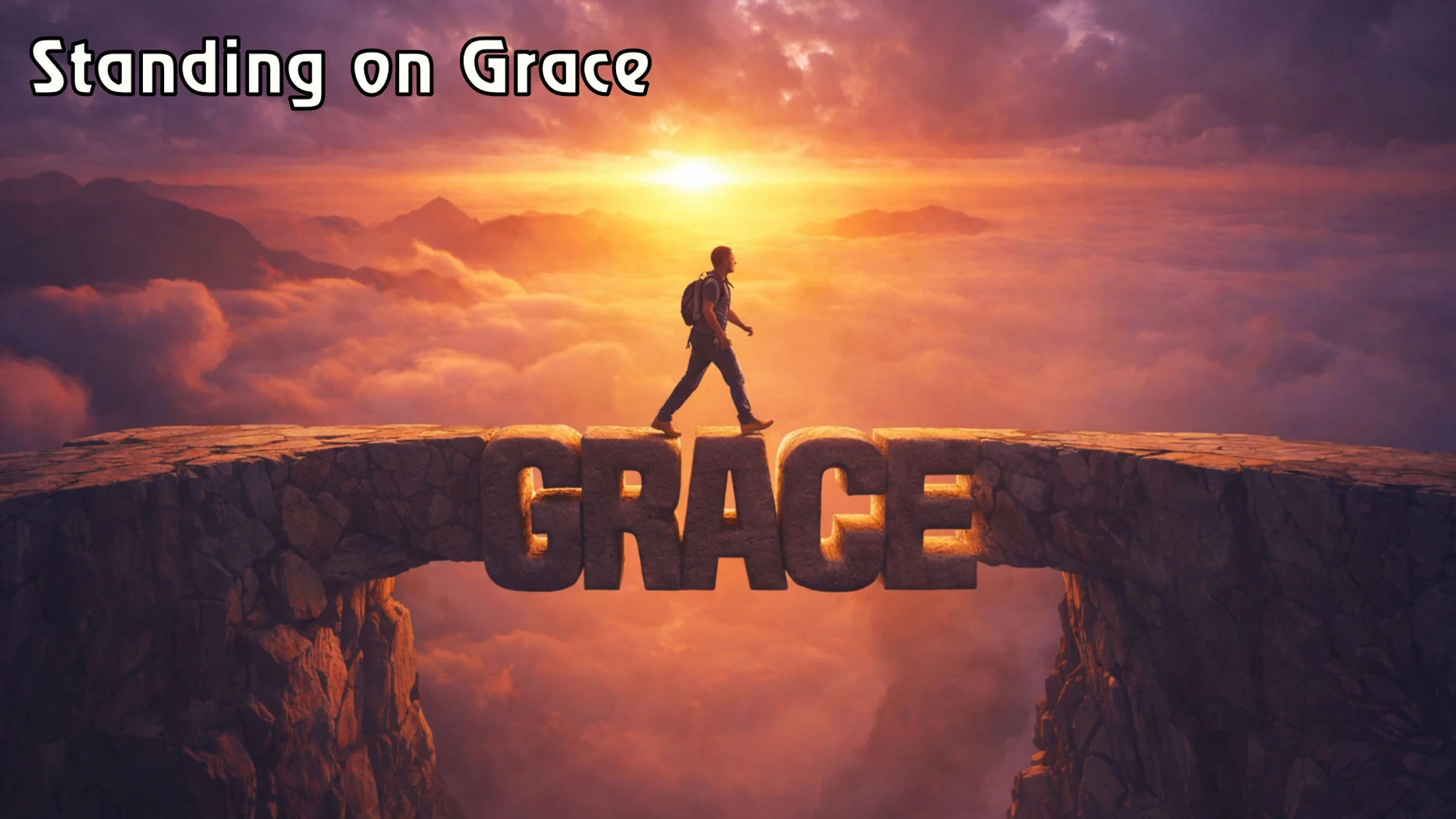
To close out our small group series, we will look to the last chapter in Galatians and answer a couple questions related to the theme of am I my brother's keeper, how can we serve one another, and what does it mean to live as a new creation in Christ.
Handout | PowerPoint | Transcript
I'm obviously biased, of course, because we have the best storytellers.
Let's pray. Father in heaven, thank you, Lord, for the opportunity to gather together once again for this last week in our series, Standing on Grace. Lord, we've gone through a lot as we close out this chapter of our series, Leading guide us, and especially be with the discussions that we'll be having in our groups this week. In Jesus name, amen. About maybe 10, 12 years ago, I suddenly became.
I discovered an ailment in my right leg and I could not walk properly. I think I got to about the third day. It became very uncomfortable to where I couldn't put any weight on it. It decided to swell up. I don't know how much longer I tolerated it, but I remember being in church, it was vbs that evening, and I was hobbling up and down the sanctuary because I realized I had to go and pray.
So I hobbled my way down there, prayed, came back. One of the dear sisters in the church, you know, a mom came up to me and she asked, are you okay? And I was like, I'll be fine. I'll just. I'll let it pass.
She then told me she gave me some very sage advice in a very motherly, but firm motherly tone. Go to the doctor.
To which I wanted to say, if you're not my mom, I went to the doctor. And when I went to the doctor, I was able to get what I was dealing with diagnosed and treated. I was rather stubborn, though. I thought that I could make sure. I'll be fine, right?
I'll be fine. Throw some dirt on it. I'll be fine.
I'm grateful for her because she. I don't want to say she confronted me, but she could see that I was in pain and that I was hurting and I was a hindrance. My brain was a hindrance to my overall health. And she pulled me aside. And I'm grateful that she did and told me, maybe you should consider getting some help.
I didn't want any help as a young man. I'll get over it. I'll be fine. Now. I have no problem asking for help when I get sick.
I'm not afraid to go to urgent care. I want to go to the Book of Galatians, chapter six. We're going to be in Galatians a little bit today.
Our sermon title for today is Am I My Brother's Keeper? I should have actually titled it, Am I My Brother's or Sister's Keeper? Are We Responsible for each Other? And I want to start this out with Galatians 6, verse 1. Okay.
And Paul starts the verse with a rather firm note. Chapter six, verse one. Brothers and sisters, if someone is caught in a sin, you who live by the Spirit should restore that person gently. But watch yourselves, or you also may be tempted. I relay that back to a friend of mine who obviously could see that I was hurting.
I don't want to say this. I was suffering. And she could see that I was in deep pain. But I didn't know how to resolve the situation. Have you ever been at a point in your life where you were dealing with something, or maybe you made a mistake and you did not know what to do and you were stuck, but nothing was changing and your life was going down the drain?
Somebody came in with love, with concern, asked, are you okay, or can I help you?
I'm reminded that the church is a living organism. The church is a living organism. What I mean by that is that the church is not static. We don't just come here to church and pray, sing music, listen to me or Bill, and go home. It's beyond that.
And I know that because I've seen and experienced that in the life of this church. I think it's fair to say we love each other. Amen.
Again, I am biased, but we have a great church. We have a culture that truly cares for one another, that goes beyond these four walls. It goes beyond these four walls. We have to. Otherwise, we're just a club.
And I think it's one of our great desires that we be more than just a club. We want to make a difference in the city of Downey and wherever we are.
But the church is not static. It's growing. And when growing happens and occurs, is growth always fun, or can it be painful? It can be painful sometimes, especially if you've been hurt and you're on the path of recovery. You have a major surgery is everything.
You have a major surgery, are you ready to run a marathon the next day? You might be in rehabilitation for a couple of days or a couple of months. It might take a year or two to make yourself be whole again. And one of the things that I love about our church and the church in general, is that when you have a good church, you're able to be real and you're able to be vulnerable, or you're able to be able to talk to each other, check on one another. Paul writes in Ephesians 1:22, and God placed all things under his body and appointed him to be head over everything for the Church, which is his body, the fullness of him who.
Who fills everything in every way. He mentions it also, I think it's in 1 Corinthians 12. He describes the body where God's the head, but you have the hands, you have the fingers, you have the skin, you have the pancreas, you have the heart, you have legs, you have the epidermis. And all of these different functions. There's thousands of different functions of different parts of the body, and they all have the goal of functioning together.
Now, you can get away without your small pinky toe, but even without it, does that inform how you walk? Can you run and walk normally even if you lose that pinky toe? Not that I've lost my toe, but I have been informed by those who do. It's like, no. It changes your balance.
And what often happens is that you learn how to walk, but you still have to. What? You still have to, in some ways compensate for it. Or if you've been hurt, okay? Like I was hobbling around, not only was my right side hurting, but my left side, my hips were hurting because I had to compensate in how I walked.
I was not whole. I was struggling. And sometimes in life, there are choices, our decisions or things that happen to us.
We make choices, and they could be good choices, or they could be poor choices. And we live with those choices. Sometimes they're good choices, and sometimes they're bad choices. And some choices could send us down a narrow, dark path where it feels like, I don't know how to get out of this pit, but I'm too scared to ask for help or to say something.
The body will know when something is hurting, and they'll try to fix it.
You could cut your skin, it's going to bleed, but eventually what happens? You'll get a scab that covers it, right? And under the scab, new skin grows, and eventually the scab will wither away. Maybe you're fighting a cold, you get a virus, maybe you get a cough, you get a fever, but your immune system kicks in to try and fight that. Maybe you'll get a broken bone.
What happens? A break occurs. You gotta go to the doctor, maybe to reset it. Or maybe you eat something bad and your body says, throw it up because it's not good for you. Maybe you get swelling after an injury, you bump your arm, next thing you know, it's red, it's swollen.
That's blood being sent to help fix you.
In our first verse, it says, brothers and sisters, if someone is caught in a sin, you who live by spirit should restore that person gently. The word restore is katar tit. I can't even say it right now. Kathartezete, which means to restore or to mend, or if you were to go deeper, it means to restore to its previous condition or mend a broken bone. This word's used in several times.
It actually also is referred to when the disciples went fishing and they had to mend and fix their nets. When somebody's on a dark path and you know that their life is upside down, should we just let that person flail and flounder, or should we reach out and say, flounder? First off, hey, man, are you okay?
And just as I was stubborn, we often will say, no, I'm fine, everything's fine. My foot's on fire, but everything is fine, right? One of the hardest things that we can ever do is to ask for help. But I firmly believe that when I've needed help, very rarely have I ever been told no. I've actually learned that people will want to move mountains for you if you need help.
We're called, though, when our brothers and sisters are in pain or need healing, we're called to help restore them, to mend them. But I think the question too is, well, who's responsible for that? I think the first thing that we have to be mindful of. It's not everybody, though, should be doing this task, but somebody who is mature in faith, someone who's maybe been around the block. One of the things that I've discovered and I live by with my life, when you deal with something that's challenging with another person, what should you.
What was Jesus prescription? Go to them. What, by yourself? And I don't say, hey, why are you messing up this way? Don't lead with a hammer.
Lead with a question. Are you okay? Or what's wrong? Or why did you say that about. About me?
Because it gives them an opportunity to be able to share without a bunch of other people. You give them dignity to be able to start that path to being, to being mended, or to be restored. If it's a conflict, then we say, hey, let's bring some couple people that we both trust who maybe have an objective mindset, a third party. And if that doesn't work, maybe a bigger group. And if that does not work, then what does Jesus say?
Treat them as a pagan. That kind of sounds harsh, but what Jesus is really trying to say is treat them as if they don't know anything. Start over, hit the reset button or reboot and it helps them to see that there is hope. You've helped, tried to help them. Now they could also just completely say, I never said that, or I don't want help.
We can't force somebody to get well. Amen. It's so frustrating when you see somebody that you love and care about.
It's so frustrating to see loved ones make horrible decisions. I have somebody that I love very much and found out, made some poor decisions, and I can't do anything about it because my natural instinct is to want to fix this person, but I can't fix this person. And one of the things that maybe that the first thing that we can also do is we can pray for them. Let's go back to chapter six. Chapter six, verse two.
It then says, carry each other's burdens, but in this way you fulfill the law of Christ. This last week we talked about the fruits of the spirit. And one of the fruits that we talked about in verse 23 is goodness and love. When you carry a burden, do you do it out of obligation or because you want to help that person? It's all rooted in love.
And as it all goes on to say is you fulfill the law through what? Love. Love. Those who are struggling, let them know that they're not alone. Some examples that I can think of when you talk about carrying the burdens of others is the Good Samaritan who helped somebody who wasn't part of his tribe.
If anything, the Samaritan was somebody that you did not give praise to if you were a Jewish person. But he doesn't care. He sees a struggling person and actually gives of his own money and time to help this person. I think of Simon of Cyrene who helped Jesus. Moses was supported by Aaron and her.
Aaron. Aaron's arms. Sorry. Moses arms were falling in the battle. They were losing.
And all of a sudden Aaron and hur grab his arms and the tide shifts. Literally helped him. Ruth and Naomi. Ruth did not abandon. They went back to Naomi's home.
You have the in mark. You have the friends of the paralytic who was they cut through the roof and lowered him down to ensure that their friend could find healing. We also see in early Acts chapter two that the early church shared what they had not only to be to be to make sure that people were not in want, but they had band together because their lives were threatened. You know, in more recent times. I think of Mother Teresa, who dedicated her life to India to help those who were less fortunate.
Harriet Tubman Maximilian Kolbe. He was A. I think it was a Franciscan priest. And During World War II, he helped to shelter thousands of Jews. He was eventually caught. He was arrested.
He was taken to a concentration camp. And when some, they. They were select, somebody had tried to escape. And so as punishment, I believe 10 people were asked to be pulled aside to receive some extra punishment.
One of the guys raised his hand and he said, I can't. I have a family. I have this and that. And Maximilian says, I will take his place. He suffered more, and eventually he died in 1941.
Because he was thinking of others. Maybe for today's age, we think of the friend who just stays and just wants to listen. Maybe you've lost a loved one and you have somebody who doesn't say anything, but their presence is for affirming you feel better when they're there, even though they don't say anything. Maybe it's a single parent supported by the community. I remember watching the Steve Harvey Show.
There was a mom who had a son. I think he was maybe 13 or 14 years old, didn't have a father figure in life. He sits down surrounded by all these men. Steve Harvey, and this is. I think this was in la.
He asks the men who will step up to be a father figure for this young man. I don't remember how many, but at least. I think at least five, six, seven guys raised their hand to mentor this young man. The camera panned back to the moment, and all she could do was put her hands up to her mouth and just cry. Because for years she wanted to have a stable male figure for her son stepping up to the plate.
Maybe it's also one way of looking at it as a caregiver for a loved one, which can be a very, very challenging job. Cause oftentimes it goes by thankless.
It's easy to become resentful. James 1:19 says, My dear brothers and sisters, take note of this. Everyone should be quick to listen, slow to speak, and slow to become angry. When we talk to those who are struggling, let's not judge before we understand their predicament. And you don't have to have all the answers, but what you need to have is, is a caring heart and an opportunity to explore.
How can we help? How can we fix? What can we do? We're all given gifts and talents. Those who have experience can step up and to help.
But oftentimes though, you know, we want to be a good steward. We want to be faithful. Is it possible, though, okay, that we use this negatively? So what does it mean now for you what does bearing one of the burdens to you? Because I think we all, many of us have noble desires of wanting to be compassionate, to be helpful, to be caring, to be kind, to be loving.
On the flip side though, we're far more likely to serve others at the expense of our, dare I say, pride or well being. Maybe you want to serve others because you can say, well, now you owe me one. You ever have that happen to you? You help somebody and then they take it and say, well, yep, now you owe me.
Or well being. We become a martyr, the martyr complex. Well, I've been helping you for so long.
Oh, but we're almost done. Or no, we're not finished yet. And then we become what? Resentful? We hold grudges.
What is Paul trying to teach here? And the heart of it is we are called to love one another. That is the fulfillment of the law. As Jesus says, love your neighbors as what? As yourself.
You see, I think many of us, if we see somebody who's suffering, do we not want to see them not suffer? Right. Take them to the doctor, get some medicine, get an X ray, diagnose what needs to be done.
We are just. We should be wanting to be to. We should lead with love and kindness. We want to be sincere. Maybe we're motivated by faith or moral conviction.
Maybe you experience joy and fulfillment when you help somebody out. I know I shared a couple experiences where I discovered that. Look, getting stuff is nice, I think we can agree on that. But life is more fulfilling when you're making a difference in somebody's lives.
The thing though is sometimes over time we may think, well, I helped that person, now I should get something back, or they helped me and I feel obligated to give back. At its core, when we give, let's not expect anything in return. So real love, real being kind comes from real love. Not based on ego or fear. We seek to do good for others, not to not for our self benefit.
Helping others also, I would say, even has healthy boundaries. If you have a bad mindset, you ignore those boundaries. True love builds others up, it doesn't tear them down.
So as we move forward, friends, what does carrying another person's burdens look like? Do we do it out of love? Do we do it out of obligation? I don't think Paul wants us to be taken advantage of. Let me be clear on that as well though.
But where we can, I think it is good to do good.
As we continue verse seven, it says, do not be deceived. God can't be mocked. A man reaps what he sows. Whoever sows to please their flesh, from the flesh will reap destruction. Whoever sows to please from the spirit, from the spirit will reap eternal life.
Let us not become weary in doing good, for at the proper time, we will reap a harvest if we don't give up. Therefore, as we have opportunity, let us do good to all people, especially those and who belong to the family of believers. What is Paul trying to convey here?
If we have the fruits of the Spirit, should we not be loving? Should we not share joy? Should we not try to do good?
What are you investing your life in to make a lot of money, to get power and authority, or to make a positive difference in people's lives?
You can want money, you can get it, but will you be fulfilled by it? And I'm not saying money is bad, but how much value you place on it could be a detriment or a hindrance to your walk with God. Because if we seek to get as much and serve the almighty dollar, you can be satisfied for a while. Money can bring fun for a while, but is it fulfilling? I was talking last night with our group and I shared with.
At the end of the day, I want to be able to have as many experiences as possible because I have a very curious nature. I wanna see stuff, but more importantly, I wanna be able to experience that with others. Are you building memories up within your own family and the church family here? As we do life together, as we build relationships? The last couple days, I found a comedian that he's hilarious, he's really good, and he's a clean comedian.
And he shared a story and I related it so well. So several years ago, was it two years ago, I didn't ask her permission, but Earlinda took me to a Rams game. It was fun. It was great. It was amazing.
And we walked around and I could see the tailgate party and what the comedian was saying. You know, he got tickets to go to a suite where you could eat and drink whatever you want. And it's a great view. But the guy, his host who took him also said, you need to be there early at 9am because that's when the tailgating begins. And in the tailgating is where relationships also begin.
Because everybody was bringing their barbecue, they were bringing their spring rolls, they were bringing all kinds of food and they weren't charging. They were just, hey, here is some food.
And then what I bring back to is we went inside of the stadium and we sat in her spot and what was so cool to see where all the relationships that she's developed be. These are her people, her tribe, and I don't know any of these people. And I'm guessing they probably all had different perspectives on life, but it didn't matter. They had one singular focus, the Rams to destroy. I forgot who they're playing.
I'm sorry. But, oh, Seahawks, Yeah, unfortunately, we lost, but I love that environment because they all had the sole purpose and they were there to support. And even when we lost, we still were family. We were still together. You know, you go to other places like Costco and Sam's, they have memberships.
We're all members here. But, you know, when you go to Costco and you go to Sam's club, they don't judge you. In fact, they have snacks. You could sample the different snacks. You can try different things.
When we come to church, when we are a living organism, we build up. We don't tear down. And if they see somebody struggling, I hope and pray that here at Downey Church, let's not let them wallow, let's not let them flounder. Let's help them.
We don't do life on our own. We are a church. We are an organism. Cain, after he murdered his brother, said, am I my brother's keeper? Are we our brother's keeper?
I would reframe it another way in that we look out for our family, we care for our family, and we love our family. In the good times and in the challenging times, we could all start with a word of prayer for them and walk with them in the journey. That is my prayer and my hope. Let us love one another. So reflection.
When you see somebody struggling, do you judge? Do you avoid?
Or do you show compassion to them? Do you judge, avoid or show compassion?
This week, I want you to go and I want you to pray and encourage somebody every day. I said, this week, I want you to just do this every day. Find somebody. It could be the same person or it could be a different person every day. I don't care.
Could be somebody in your family. Could be somebody your coworker, fellow classmate, your neighbor. If you really want to make it challenging, pray for that person that annoys you and gives you grief.
Just maybe your relationship may change. So pray for and encourage someone every day. Father in heaven, thank you, Lord, for you are good and your mercy endures forever. Lord, as we talk in our last week in our small groups, bless, lead and guide us. Provoke us, Lord.
How can we love better? How can we care for one another better open our eyes and Lord, the dangerous part I'm going to ask give us opportunities to be a blessing to others. Thank you for your goodness. In Jesus name, amen. Grace and peace.